Call us on 0800 000 856. We look forward to seeing how we can help.
Free Phone 0800 000 856

Multiple Sclerosis
Our team is dedicated to helping you manage the challenges of MS through personalised treatment plans that focus on improving mobility, strength, and quality of life. We use the latest evidence-based techniques to address issues such as muscle weakness, balance problems, and fatigue, helping you stay active and independent. Whether you are newly diagnosed or seeking long-term support, we are here to guide you every step of the way towards better physical health and well-being.
Evidence has shown that exercise and rehabilitation is still the only way to improve functional outcomes in individuals with MS, and the best time to start exercise is at diagnosis. We offer one on one physiotherapy sessions, physiotherapy assistant sessions, and a small group gym option.
We are also proud to run MS Get a Head Start programmes here in Ōtautahi Christchurch and your physiotherapist will let you know if this is right for you.
What is MS?
MS is a condition of the brain and spinal cord, which together make up the central nervous system. Your brain controls your bodily activities such as movement and thoughts, and your spinal cord is the central message pathway via nerves. Surrounding your nerves is a protective lining called myelin which helps these pathways send messages quickly and smoothly from the brain to the rest of the body.
It is thought with MS that your body’s immune system identifies this myelin as a foreign body such as bacteria, and attacks it, stripping it off the nerve either completely or partially leaving scarring called plaques or lesions.
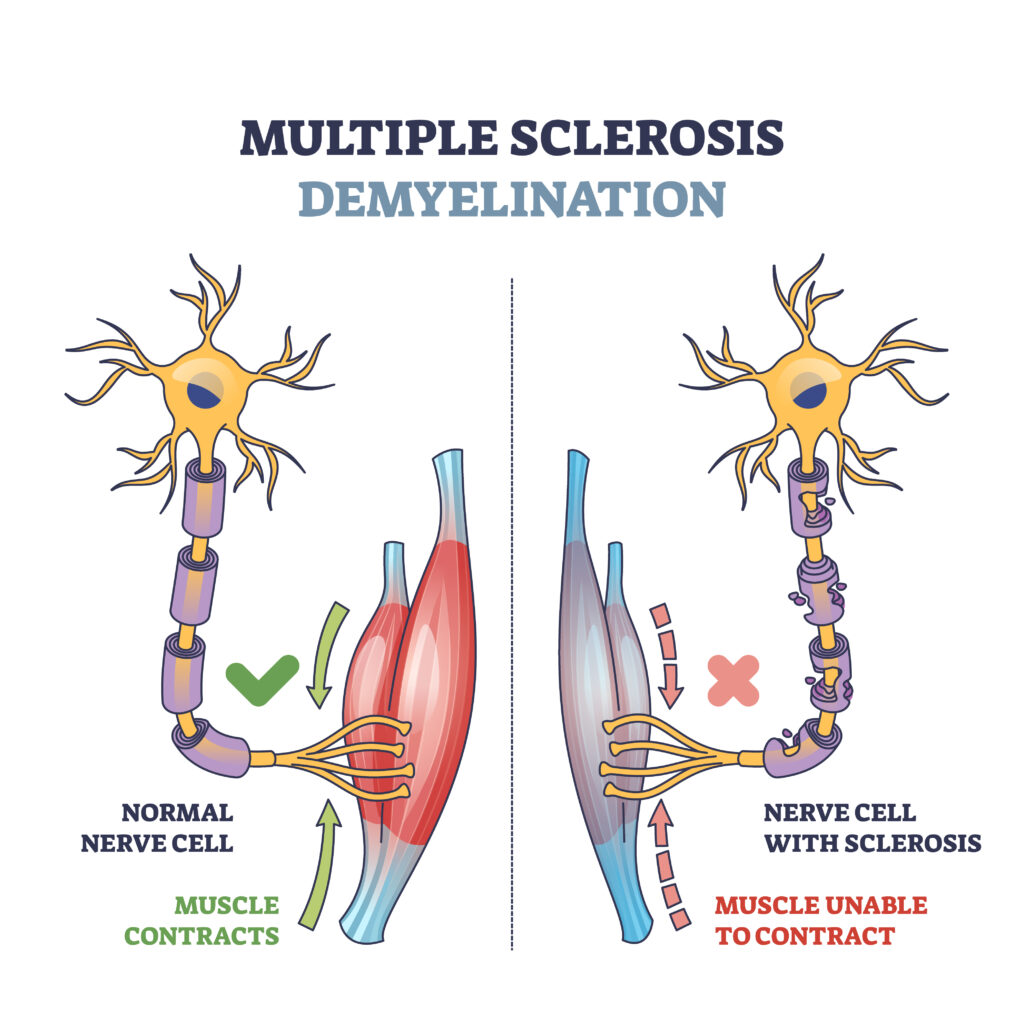
The damage to the myelin disrupts nerve message pathways by either slowing them down, distorting them or completing stopping the messages from getting through. As well as damage to the myelin, there can also be damage to the nerve itself, and it is the nerve damage that leads to more severe disability over time.
Everyone with MS will have their own unique symptoms relating to the area of the central nervous system that has been affected.
The cause of MS is unknown but is believed to be a result of environmental and genetic factors which lead to the body’s immune system malfunction.
The main symptoms of MS include:
- Fatigue
- Difficulty walking
- Vision problems, such as blurred vision
- Problems controlling the bladder
- Numbness or tingling in different parts of the body
- Muscle stiffness and spasms
- Problems with balance and co-ordination
- Problems with thinking, learning and planning
Types of MS
There are three main types of MS, each with its own characteristics, but each as unpredictable as the other. It might not be clear which type of MS you have when you are first diagnosed. However, by noting changes over time, Neurologists should be able to clarify which type you have.
Relapsing Remitting
This is when you have a relapse (flare up of symptoms) followed by periods of remission (recovery). Relapses may last days, weeks or months and can be mild to severe. You can develop new symptoms or can experience a reoccurrence of previous symptoms. During remissions, symptoms can completely resolve or may only partially recover.
Secondary Progressive
Most people who are initially diagnosed with relapsing-remitting MS will go on to develop secondary progressive MS. This is defined by your symptoms becoming steadily worse, and disability progressing over a period of six months or more. In this time relapses can still occur but with no remission.
Primary Progressive
This is where your symptoms steadily worsen from onset, resulting in continued progression of disability. You will not have distinct relapses and remissions.
There is a fourth category called Progressive-Relapsing MS, this is a very rare form of MS, and only affects only a very small percentage of individuals.
Medical Management of MS
Disease modifying drugs (DMD’s).
These treatments are not a cure for MS but the main benefits can be:
- Fewer relapses
- Less severe relapses
- Help reduce the build-up of disability which can occur if you don’t recover completely from relapses.

In New Zealand there are only a certain number of DMD’s which are funded by PHARMAC. These are primarily offered for those with relapse remitting MS. But, as of 1st October 2023 there is now one funded medication for primary progressive MS.
To be commenced on these medications you need to meet certain criteria. Your Neurologist, through examination and history taking will be able to advise you if you have met these criteria. Once commenced on a DMD every 12 months you will complete a 100m walk test which can be performed with or without a walking aid for your funded medication to continue.
There are also some non-funded medications available in New Zealand which you can discuss with your Neurologist.
Relapse management
People with relapsing-remitting MS may experience 1-2 relapses per year which are generally treated with corticosteroids which are effective in hastening a recovery from an attack.
Autologous Haematopoietic Stem Cell Transplant (AHSCT)
AHSCT is not currently funded or carried out in New Zealand. To find out more about this treatment go to https://msnz.org.nz/stem-cell-treatment/
How Neurological Physiotherapy can help your MS;
Our neurological physio team will complete a comprehensive assessment of your functional abilities. From this they can create at tailored program with you, which may include working on your balance, weakness, and spasticity.
There are exciting developments in research to show that exercise can have a protective effect on the central nervous system and could have a positive effect on disease progression. Endurance exercise in MS clients has also been shown to improve walking distance. Research has shown significant positive effects of physiotherapy on balance for individuals with MS who have mild to moderate levels of disability. Regular exercise can reduce the levels of inflammatory markers in the body, which are commonly elevated in people with MS.
It is key to understand that the body remyelinates through movement. Remyelination, protection of the nervous system and potential growth of new nerves are all activity dependent. What that means is, if you are not exercising or active then your body’s normal neurological activity will slow and decline, exacerbating MS symptoms.
It can be daunting to think about starting up a new exercise program, particularly if you have had a bad response to exercise in the past. Two of the most common barriers we see to doing exercise for clients with MS are fatigue and heat sensitivity.
Fatigue:
This is the most common symptom of MS affecting 75-90% of people diagnosed. There are 3 main types of fatigue that effect people with MS.
- Central fatigue
- This is the activity of the central nervous system at rest, and for those with MS it is much higher than for someone without. This causes more energy to be used, even when you are resting.
- Secondary fatigue
- This is fatigue caused by something that can be hopefully altered or improved, such as pain, spasms, medication, sleep disturbances and stress. This type of fatigue will cause anyone to be tired, however, most can be proactively managed by discussions with your GP, neurologist and treating exercise professional.
- Neuromuscular fatigue
- This is direct fatigue of a muscle. This occurs due to damage of the nerves that tell that muscle to work. Examples of this is foot drop that you might not notice when you first start to walk but after 10 minutes it becomes very noticeable, or weakness in your hand after typing at work for a period of time.
There is a common concern amongst people with MS that exercise increases fatigue, however there is significant evidence that shows exercise does not increase fatigue if done in the right way. In fact, regular exercise has been shown to significantly improve fatigue levels.
The main issue is that most people overdo their exercise initially, which then makes them feel worse and then they avoid doing exercise again. This is why it is important to seek out physiotherapy support to help guide you through the right type and amount of exercise.
Some tips to help manage your fatigue.
- Regular exercise
- A good tip is to alternate the body part you are exercising so to allow muscles to recover i.e do an upper body exercise and then switch to lower body
- Regular breaks
- One of the most effective things you can do is to schedule a 20 minute rest at the same time each day, ideally just before you normally get fatigued. This means complete rest for 20 minutes with NO stimulation, no TV, no mobile phones, no reading etc. The one thing you can do is listen to some guided meditation. You have to spend 3 to 4 weeks doing this for your body to settle into a routine and to start to notice the improvements
- Pacing
- It is important to avoid “Boom and Bust” i.e. when feeling energised trying to do to much in one go and then feeling exhausted. Instead spread your activities out over the day or week and allow plenty of rest time.
- Routine
- Regular fluids
Heat Sensitivity
Between 60% and 80% of people with MS find that heat can cause their symptoms to worsen. This is because an elevated core temperature, even by as much as 0.5 degrees, can alter how well your nerves send messages. There has also been research that shows people with MS do not sweat as efficiently, therefore struggle to regulate their body temperature.
It can be a scary experience if you have done exercise and suddenly become more symptomatic. However, research shows that proactive cooling prior and during exercise by drinking ice-cold water can reduce symptoms and improve output during exercise. Some other tips on cooling include;
- Cold bath or shower

- Body cooling garments such as ice vests or ice scarfs – these can be purchased online.
- Ensuring you have a cool environment to exercise in (e.g. use of air conditioning and fans)
- Drinking ice-cold liquids – place a bottle in the freezer and take out 30 minutes prior to exercising or going out in the heat.
Hydrotherapy is also often one of the most beneficial ways to exercise if you are heat sensitive as long as the pool is not warmer than 34 degrees, and the air in the building around the pool isn’t too stagnant. Try to use a pool that has good air flow or has fans that can be turned on to keep the air moving.
Early input from a neurological physiotherapist for your MS symptoms can help in maintaining functional capacity and reducing risk for losing important abilities or independence.
Our neurological physiotherapists are ready to assist you with your MS journey.
For more information, or to make an appointment contact us on 0800 000 856